Federal Reser2026-08-28 21:14:26Cleveland Fed's Hammack: Balance Sheet Impact on Economy Deeply UncertainCleveland Fed President Beth Hammack says the Federal Reserve faces deep uncertainty over how its huge balance sheet is affecting the economy, and she called the challenge of pinpointing when reserves move from abundant to scarce 'extremely difficult.' Hammack, speaking in remarks covered by CryptoBriefing, argued that the era of low interest rates may have distorted market benchmark expectations and that policymakers currently lack a clear model for judging how the size of the balance sheet influences borrowing costs and risk behavior. She supports reducing the balance sheet at a moderate pace, with reserves kept 'slightly above ample' — a level designed to avoid a repeat of September 2019, when depleted reserves sent overnight repo rates soaring. At the same time, she warned that too large a balance sheet carries costs: higher interest payments to banks, lower remittances to the Treasury, and the possibility that suppressed market volatility encourages excessive risk-taking.910
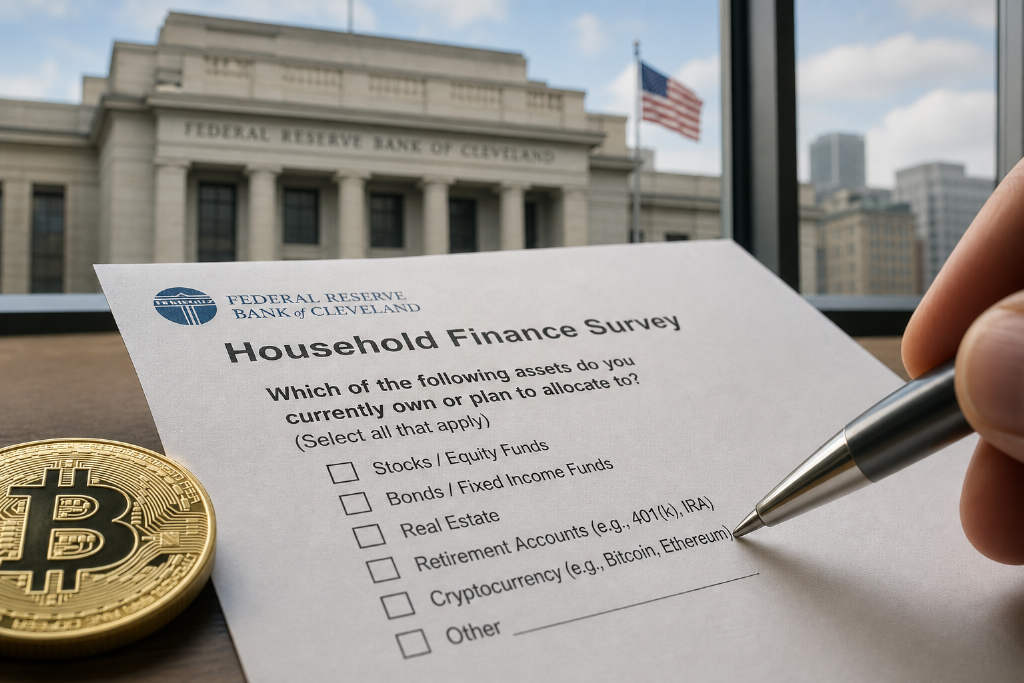
Federal Reser2026-08-27 11:33:55Cleveland Fed study says crypto ownership is driven more by beliefs than demographicsA new study from the Federal Reserve Bank of Cleveland argues that crypto ownership is explained more by investors’ subjective expectations for returns and risk than by standard demographic factors such as age, income, or gender. The paper, titled Do You Even Crypto, Bro? Cryptocurrencies in Household Finance, was written by Michael Weber, Bernardo Candia, Olivier Coibion, and Yuriy Gorodnichenko and draws on multiple large-scale surveys of U.S. households, with as many as 25,000 households in each round. The researchers found that, even after controlling for other factors, people under 40 were about 13 percentage points more likely to hold crypto than those over 60, while men were about 4 percentage points more likely to hold it than women. Still, beliefs carried more explanatory power. Among respondents willing to forecast returns, crypto holders expected an average 22% return over the next year, compared with roughly 7% for non-holders. A 1 percentage point increase in expected crypto returns was associated with about a 0.8 percentage point increase in the likelihood of holding crypto. The study also found that providing respondents with Bitcoin’s past 12-month return raised the average portfolio share they wanted to allocate to crypto by about 2 percentage points from a control-group baseline of about 4.3%, and increased the likelihood of later purchasing crypto by about 2.5 percentage points.950
Federal Reser2026-08-24 05:32:19Cleveland Fed study says Bitcoin return beliefs can drive crypto buyingA research report released by the Federal Reserve Bank of Cleveland found that beliefs about returns are a strong predictor of whether investors hold cryptocurrencies. The study said Bitcoin’s historical performance data can significantly increase subsequent purchase activity, pointing to a measurable link between market performance and investor behavior. According to the summary cited by Techub News, the report examined the relationship between investor behavior and crypto market data. Its findings add empirical support to efforts to understand what drives demand for crypto assets, with return expectations and past Bitcoin performance emerging as key factors in purchase decisions. The report was referenced by Crypto.news in the Techub item. No additional details on methodology, sample size, or time period were disclosed in the source provided.1080
Policy Regula2026-08-23 15:30:53Cleveland Fed paper says crypto ownership is shaped more by beliefs about returns than by demographicsA working paper from the Federal Reserve Bank of Cleveland argues that cryptocurrency stands apart from traditional assets because investor beliefs about future returns matter more than standard demographic traits in explaining who owns it. Drawing on repeated surveys covering as many as 25,000 US households per wave, the authors found that crypto holders and non-holders differ sharply in both expected returns and perceived risk. In the 2021 survey, many respondents said they could not even estimate what crypto might return over the next year, a sign that the asset class remains poorly understood across much of the population. The paper also reports results from a randomized information experiment conducted in 2025. Households that were shown Bitcoin’s previous 12-month return raised their desired crypto portfolio allocation by about 2 percentage points from a 4.3% control-group baseline, and subsequent crypto purchases increased by roughly 2.5 percentage points. The researchers say this points to a mechanism through which past gains can draw in new buyers and reinforce price moves. They also found that a doubling in Bitcoin’s price increased the likelihood of durable-goods purchases for households fully invested in crypto, while leaving ordinary spending unchanged, leading the authors to compare crypto gains to gambling or lottery income rather than a lasting rise in wealth.1210
Federal Reser2026-08-23 15:41:19Fed study finds crypto investors are driven more by beliefs, and Bitcoin gains data can lift buying intentNew research from the Federal Reserve Bank of Cleveland says cryptocurrency investors differ sharply from investors in traditional assets, with expectations for future returns and risk doing more to explain crypto ownership than standard demographic factors such as age, income, or gender. The paper, titled Do You Even Crypto, Bro? Cryptocurrencies in Household Finance, draws on multiple waves of U.S. household survey data, with each round covering as many as roughly 25,000 households. According to the study, crypto holders expect average returns of about 22% over the next year, compared with about 7% among non-holders, and they also tend to view crypto as less risky. The researchers found that a 1 percentage point increase in expected returns is linked to about a 0.8 percentage point rise in the probability of holding crypto. In a randomized information experiment, simply showing respondents Bitcoin’s gains over the previous 12 months raised planned crypto allocation by about 2 percentage points and increased the probability of an actual purchase by about 2.5 percentage points.1190
Cleveland Fed2026-08-10 19:10:48Fed's Hammack Says Multiple Rate Hikes May Be Needed as Inflation Still Above TargetCleveland Fed President Beth Hammack said inflation has yet to return to target and the Federal Reserve may need to deliver multiple rate hikes. She noted a single 25-basis-point increase would not have a major impact on the economy, while declining to forecast the exact number of hikes or the terminal rate. She added that the current 3.5%-3.75% range is not significantly restraining economic activity.1750
Federal Reser2026-07-19 08:34:12Cleveland Fed President Hints at More Rate Hikes as Traders Price 65% Odds for SeptemberCleveland Federal Reserve President Hammack signaled that the Federal Reserve may need to raise interest rates to rein in inflation that remains persistently high. The remarks pointed to a still-hawkish policy stance at a time when rate markets are assigning relatively low odds to a move in July but a much higher probability to action in September. According to the figures cited in the report, interest rate futures traders currently see about a 15% chance of a Fed rate hike in July and roughly a 65% chance of a hike in September. The update was reported by Odaily and cited Jin10 as the source. The latest pricing shows that market participants are placing greater weight on a possible move later in the quarter rather than at the next meeting.1890